
As the cryptocurrency market heats up with more and more crypto options, financial alchemists have cooked up new, exciting (and risky!) ways to invest in the trendy commodity, developing structured products to tantalize investors looking for income, but at significant risk of losses.
In a 2025 article entitled "The Evolution of Structured Crypto Products," CoinDesk called exchange-traded funds (ETFs) a "gateway drug" to structured products, citing BlackRock ETFs (BlackRock calls them "iShares") as one such product that has brought new investors into the crypto market. You might remember the name BlackRock from our article, "10 High-Yield Bond Funds Posting Largest Negative Returns Over the Past Year." BlackRock High Yield Bond Inv A clocked in at number four, while iShares by BlackRock had seven funds on 2016's list of 20 worst performing oil, gas & emerging market funds.
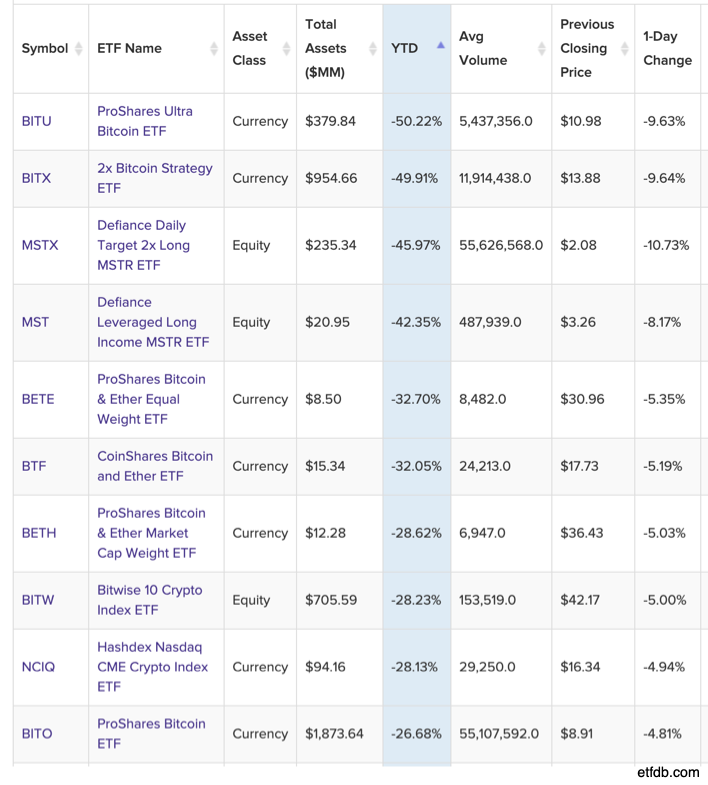
BlackRock's iShares Bitcoin Trust ETF, for instance, is down more than 26% year-to-date, as of February 24, 2026, but no Bitcoin ETF is performing more poorly in 2026 than ProShares Ultra Bitcoin ETF (BITU), down 50% since the start of the year.
Rounding out the Top 10 list of Worst Performing Crypto ETFs in 2026 are 2x Bitcoin Strategy ETF (BITX) -49.91%, Defiance Daily Target 2x Long MSTR ETF (MSTX) -45.97%, Defiance Leveraged Long Income MSTR ETF (MST) -42.35%, ProShares Bitcoin & Ether Equal Weight ETF (BETE) -32.70%, CoinShares Bitcoin and Ether ETF (BTF) -32.05%, ProShares Bitcoin & Ether Market Cap Weight ETF (BETH) -28.62%, Bitwise 10 Crypto Index ETF (BITW) -28.23%, Hashdex Nasdaq CME Crypto Index ETF (NCIQ) -28.13%, and ProShares Bitcoin ETF (BITO) -26.68%.
As technology and financial industries continue to evolve, brokers and investment advisors are turning to ETFs and structured products, including reverse convertibles, barrier-notes, and auto-callable notes, sometimes framing them as defensive tools when structured products, especially those tied to a single stock, can carry significant risk for consumers.
Leveraged or inverse ETFs, such as ProShares Ultra Bitcoin ETF (BITU), 2x Bitcoin Strategy ETF (BITX) and Defiance's leveraged ETFs in the list above, stand at increased risk due to the complexity of multiplying the underlying benchmark's performance, in this case double (2x). That's why ProShares Bitcoin ETF (BITO), which is not leveraged, lost 26% of its value YTD, while ProShares Ultra Bitcoin ETF (BITU), which is leveraged at 2x the daily performance of Bitcoin futures, has lost more than 50% of its value.
In 2024, we followed the case of ARK Innovation (symbol ARKK), an ETF that experienced significant volatility and, as a result, left investors succeptible to significant losses as ARKK's price plunged below a minimum threshold, triggering dividend suspension. ARKK reached a high of $156 per share in 2021 and by 2023 had fallen to a low of just over $30 per share.
For what it's worth, ARK's ARK 21Shares Bitcoin ETF (ARKB)'s year-to-date return is presently -26.36%.
Bitcoin and other cryptocurrency ETFs and structured products may be unsuitable for many investors, including those with conservative or low risk tolerances.
If you suffered losses after investing in a structured or complex crypto product that you believe a broker or adviser unsuitable recommended to you, please call an experienced FINRA arbitration attorney at The Law Offices of Jonathan W. Evans & Associates at (800) 699-1881 for an investigation and consultation.